
One component that many lifters overlook is the uitlization of RPE or Rate of Perceived Exertion in their training programs. RPE has been around for years but it still doesn’t get the respect that it rightfully deserves. I was a person that neglected this variable for a long time until I started using it and began to understand its superiority when compared to percentage-based training. This really began to take shape for me as I became a more seasoned lifter.
However, before I get too ahead of myself, let me briefly explain what it is. RPE is a subjective measurement from 1 to 10 that is used to describe the difficulty of a set. The higher the number, the harder the set. The lower the number, the easier the set. Mike Tuchsherer was the forerunner for the concept of RPE in powerlifting as he trained world record holders utilizing this method. He understood that lifters were subject to days of varying strength levels and that in order for progress to be made, it necessitated adjustments be made on how an individual was feeling that day. This could also be referred to as auto-regulation, which is adjusting the load based on the athlete’s present performance.
The idea that your strength levels will vary from one workout to the next wasn’t on my radar when I was young but once I got married, had a kid and had to go to work on a regular basis did it finally click that RPE was clearly the way to go. I had performed training programs that were based on percentages of my one repetition maximum and they were adequate for initially loading the bar with semi-accurate weight. However, once progress was made during the course of the program, it made the original one repetition maximum and the subsequent training percentages obsolete.
Further, the beauty of RPE is that it connects you with how your body is feeling and doesn’t allow you to keep pushing unnecessarily to hit a certain number or reps. As previously mentioned, the auto-regulation factor prevents overtraining in that it disallows the accumulation of too much stress from repeatedly executing near max RPEs without sufficient recuperation. Personally, my body would never be able to recover if I relied on my own instincts and didn’t have some semblance of restraints to properly reign in my training. I’m a high intensity person by nature, so using RPE was a vital tool to keep my progress rolling without crashing and burning too early in a training program.
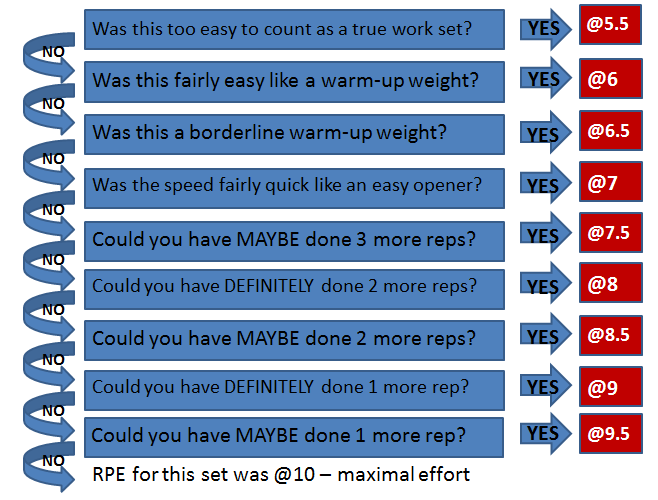
The RPE scale below is the one I mentioned earlier that Mike Tuchsherer has created. It is the one I have been following during my training sessions. The scale can be difficult to use at first as you get acclimated to it. However, the more you practice it, the better you will become and the more helpful it will be in positively affecting your lifting trajectory.
RPE also has benefits beyond the realm of powerlifting. Building muscle is another area where RPE can come into play. RPE is important with regard to building muscle because it necessitates that an individual train close to failure. The real driver of muscle growth is mechanical tension. In his article, “What determines mechanical tension during strength training?, Chris Beardsley describes mechanical tension as “the type of force that tries to stretch a material. During strength training, muscles experience stretching forces when they try to shorten, but are resisted when they do so.” In order for the action of a muscle or muscles to occur, they have to produce more force than the resistance they are experiencing. They do this by one of two methods: recruit more muscle fibers or have each muscle fiber produce more force. More muscle fibers are recruited in direct correlation to the number of motor units being recruited. If you want more muscle fibers, you will need more motor units. Nevertheless, we are going to focus on how each muscle fiber can produce more force. The amount of force a muscle fiber can produce depends solely on the force-velocity curve. When muscle fibers contract slowly, they produce high forces. When they contract quickly, they produce low forces. The reason this happens is because when muscles contract slowly, it gives more time for actin-myosin cross bridges to form and therefore, more force to be produced. When there is a fast shortening of muscle fibers, it doesn’t allow for that to happen.
So, the reason I mention this process is because when you train at a high RPE and subsequently, close to failure, there is an involuntary slowing of muscle fiber contraction velocities due to fatigue. This, as a result, enables more force to be produced by the muscle fibers (and more mechanical tension for muscle growth) because of the large number of cross bridges being formed between actin and myosin.
Anyway, I hope this article helps your strength development and muscle hypertrophy endeavors become more fruitful as you implement the concept of RPE into your training routines!
Sources:
Beardsley, Chris. “What determines mechanical tension during strength training?” Medium, https://sandcresearch.medium.com/what-determines-mechanical-tension-during-strength-training-acdf31b93e18
@liftrunbang1. “What really causes muscle growth?” Instagram, 23 April 2021, https://www.instagram.com/p/COAyQ2PJ6kQ/.